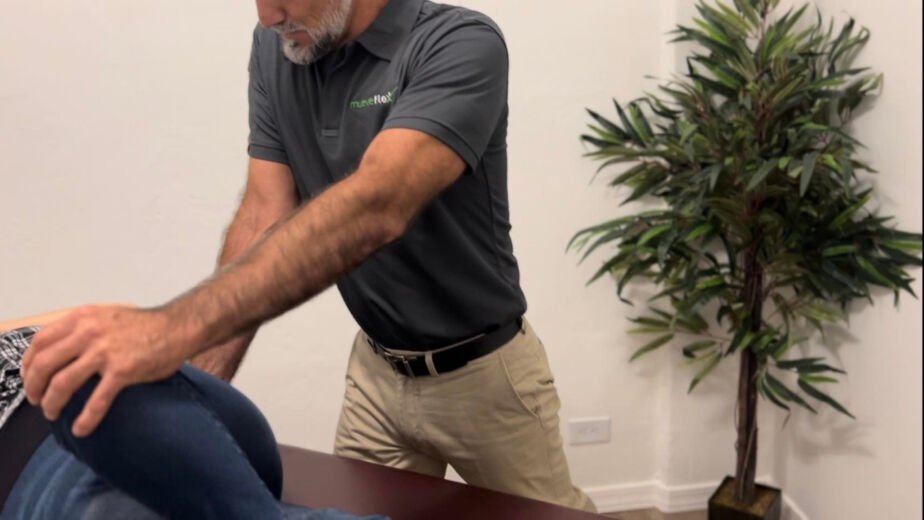
Neck stiffness, tight shoulders, and upper-back tension are some of the most common concerns patients bring to Dr. Jesus Bernal at MueveFlex Wellness Center in Tucson. Below, he answers the specific questions people ask him most often in the clinic, in his own words, from computer-related neck pain to why it gets hard to turn your head while driving.
“My neck is stiff. How can I get rid of my neck stiffness?”
A stiff neck most often responds best to gentle movement, brief posture changes, warmth, and avoiding the same position for many hours at a time. Try slowly turning your head from side to side, gently tilting each ear toward the corresponding shoulder, and taking movement breaks throughout the day. Nothing aggressive, nothing forced, and definitely no attempt to turn your head like an owl overnight.
Your neck may be asking for movement, but stiffness can have many causes. If it followed an accident, persists for several weeks, or comes with weakness, numbness, tingling, fever, severe headache, dizziness, or arm symptoms, obtain a medical evaluation.
At MueveFlex, we provide non-diagnostic assisted stretching, soft-tissue techniques, breathwork, and localized cryotherapy intended to support comfortable movement and flexibility. We do not diagnose medical conditions or perform chiropractic adjustments. Gentle motion is commonly recommended for uncomplicated neck discomfort, while persistent symptoms deserve proper evaluation.
“Why does my neck hurt after sitting at a computer all day?”
Your head is not a bowling ball, but after several hours leaning toward a screen, your neck may feel as though it has been holding one. Static posture can fatigue the muscles that support the head, neck, and shoulders. A monitor that is too high, low, or far away; unsupported arms; and a mouse positioned too far from the body can add unnecessary strain.
OSHA recommends arranging workstations to support neutral positions and providing regular opportunities to change posture or take recovery breaks. Bring the screen closer to eye level, keep your shoulders relaxed, support your forearms, and stand or move briefly at regular intervals.
Stretching can help restore range of motion, but your workstation and daily habits must also change. You cannot out-stretch eight uninterrupted hours of poor positioning.
“Why is it difficult to turn my head when I am driving?”
Difficulty turning your head may involve muscle guarding, reduced neck or upper-back mobility, prolonged sitting, or another underlying issue. The neck, shoulders, upper back, and rib cage work together when you check a blind spot; sometimes the place that feels tight is only one part of the movement.
Begin with gentle, pain-free neck rotations and upper-back movement when you are safely parked …. not while merging onto I-10. Adjust your mirrors, seat, and steering-wheel position so you are not constantly reaching or leaning.
Because limited head movement can affect driving safety, persistent restriction deserves evaluation. Seek medical attention sooner if it began after a collision or is accompanied by weakness, numbness, tingling, dizziness, severe headache, balance problems, or arm symptoms. At MueveFlex, we can work on comfortable, non-forceful mobility without chiropractic adjustments, while referring out when symptoms fall outside our wellness scope.
“What can I do for a stiff neck that will not go away?”
If the same stiffness keeps returning, look beyond temporary relief. Ask yourself: How many hours am I sitting? Where is my phone when I use it? Are my arms supported while working? Am I sleeping with my neck sharply bent? Do I ever move my upper back and shoulders? Am I clenching my jaw or raising my shoulders when stressed?
Once you have answers to these questions, you may have a better idea how to solve the problem. Use gentle heat, take movement breaks, adjust your workstation, breathe more deeply, and move within a comfortable range. Avoid forcing your neck or aggressively pulling on it.
Persistent stiffness often needs a consistent plan, not one heroic stretch performed after three months of doing nothing. At MueveFlex, we help identify movement restrictions and build a personalized strategy specific to you.
“Where can I get help for neck and shoulder pain in Tucson?”
MueveFlex Stretch & Cryotherapy Wellness Center offers personalized assisted stretching and recovery services in Tucson. We frequently help people who spend long hours working at computers, driving, styling hair, cleaning, lifting, teaching, working with tools, caring for family members, or looking down at phones.
Instead of following the same routine with everyone, we ask how the discomfort affects your real life. Can you turn while driving? Sleep comfortably? Work without constantly rubbing your shoulder? Enjoy your activities without paying for them afterward? Then we customize the session around those goals and our clinical assessment and posture screen results.
Our work may include gentle neck, shoulder, upper-back, arm, and full-body assisted stretching because the place that complains the loudest is not always the only area needing attention.
“Why do my shoulders and upper back feel tight all the time?”
Like an overloaded employee …. your shoulders may be doing too much work for too many hours. Looking down at a phone, reaching toward a computer mouse, driving, carrying bags, repetitive work, shallow breathing, and stress can keep the shoulder muscles continuously active.
Bring frequently used objects closer. Support your arms, relax your grip, move your shoulders regularly, and take deep breaths that expand your rib cage. Add gentle upper-back rotations and shoulder-blade movement throughout the day.
At MueveFlex, we commonly find that improving movement in the chest, arms, neck, and upper back helps the shoulders stop feeling as though they are permanently wearing earrings. The objective is not merely to loosen one muscle temporarily. It is to help the entire area move and cooperate more naturally.
“Why does my neck stiffness make it difficult to sleep?”
When your neck is already tight, remaining in one sleeping position for hours may become uncomfortable. Pillow height, sleeping position, daytime posture, stress, and evening phone use may all contribute.
Choose a pillow that supports your head without forcing it sharply forward or sideways. Before bed, try gentle neck movement, shoulder rolls, deep breathing, and warmth when comfortable. Put the phone closer to eye level, or better yet, put it away before your neck begins reading social media upside down.
At MueveFlex, we work on the neck together with the shoulders, upper back, chest, and breathing mechanics. Improving overall movement and reducing physical tension may help your body become more comfortable when it is time to rest.
Want Hands-On Help With It?
If neck, shoulder, or upper-back stiffness keeps coming back no matter what you try on your own, that is exactly what I work with people on every day at MueveFlex Wellness Center in Tucson. You can read more about assisted stretch therapy in Tucson or see how it compares to massage and chiropractic care. Your first consultation is free.
Dr. Jesus Bernal
MueveFlex Wellness Center
3225 South 12th Avenue, Tucson, AZ 85713
520-377-2225
Scope and Safety: MueveFlex provides assisted-stretching, mobility, soft-tissue, and localized-cryotherapy wellness services. We assess movement and personalize every session, but we do not diagnose illnesses, prescribe medication, provide physical therapy, or perform chiropractic adjustments. New accidents, severe symptoms, or urgent changes require the appropriate level of professional care. Individual experiences and results vary.